.jpg)
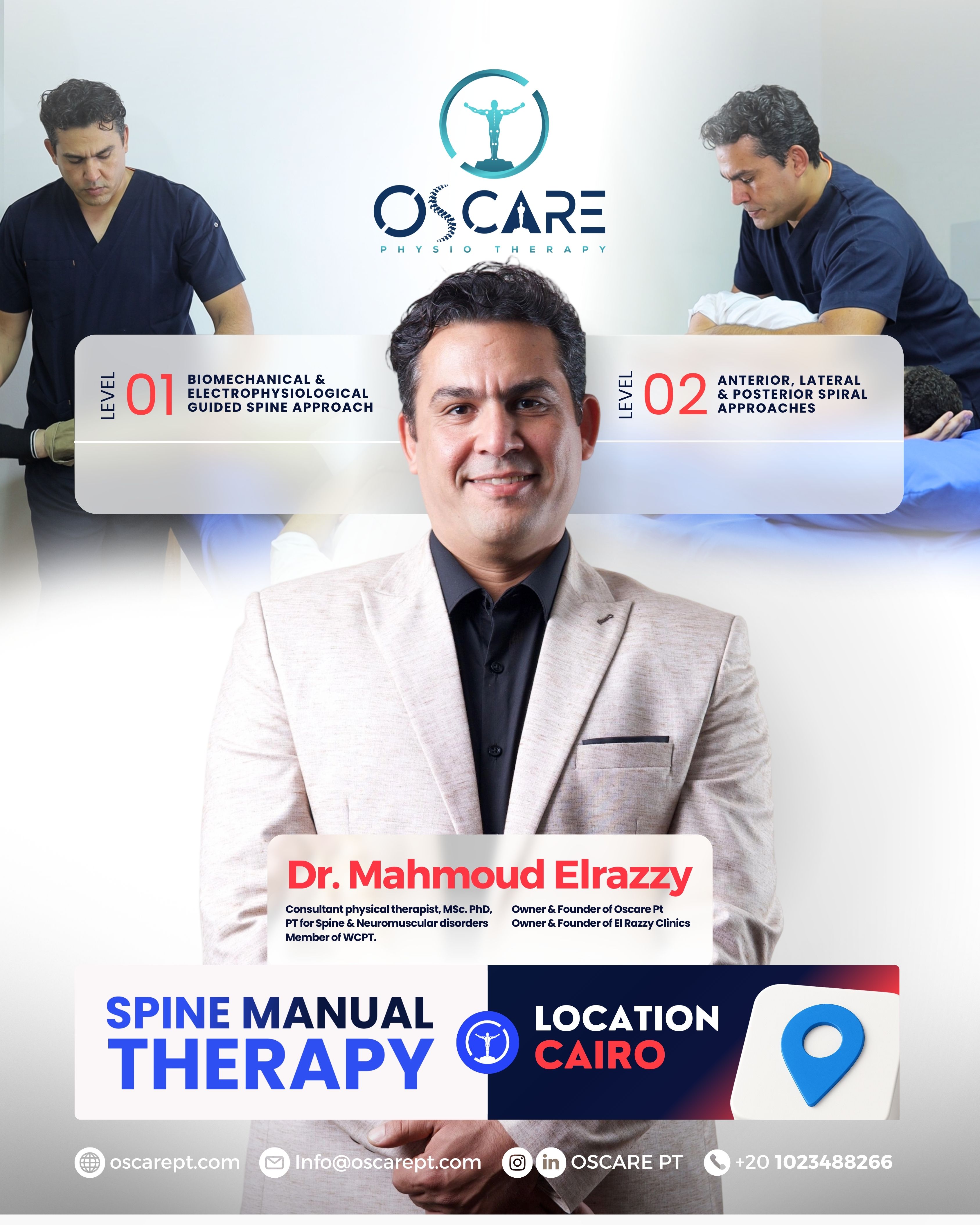
SPINE MANUAL THERAPY
in Spine manual therapy programAbout this course
About this course
Spine Manual Therapy Program — Level 1 & Level 2
Biomechanical & Electrophysiological Guided Spine Approach
Overview
Most physical therapists treat the spine using techniques they were taught by rote — without truly understanding the biomechanical and neurophysiological reasoning behind why those techniques work, or when they shouldn't be used at all. Spine Manual Therapy is built to change that. Led by Dr. Mahmoud Elrazzy, this is a comprehensive two-level program that takes you from foundational biomechanical reasoning to advanced, radiologically-informed manual therapy — equipping you to evaluate, diagnose, and treat complex spinal disorders with real clinical confidence, not just applied technique.
Course Content
Level 1 begins by rebuilding your foundation — not just anatomy, but how biomechanics actually translates into clinical decision-making at the bedside. You'll explore how radiological findings genuinely influence treatment choices, and how to evaluate and differentially diagnose the two regions responsible for the majority of spinal complaints: the lumbar and cervical spine, including Internal Disc Disruption and its various presentations.
From there, the course moves into the physiology behind decompression itself — understanding how nerve root decompression actually works, and how electrophysiological principles can guide your spinal management decisions rather than relying on generic protocols. You'll also address sacroiliac joint dysfunction, post-surgical rehabilitation, and vertebral instability — areas where many clinicians hesitate simply because they were never taught the underlying reasoning.
Level 1 closes by placing you inside the wider landscape of manual therapy philosophy itself — comparing different schools of thought and learning how to select the right approach for a given patient based on sound biomechanical logic, rather than defaulting to whichever technique you learned first.
Level 2 builds directly on this foundation, introducing more advanced and precise interventions. You'll learn radiologically-guided mobilization techniques for patients with peripheral canal stenosis, and structured manual therapy approaches for facet joint syndrome — moving from general principles into highly specific, condition-matched interventions.
The program then advances into targeted decompression strategies based on disc level and foraminal zone, along with anterior, lateral, and posterior spiral approaches — techniques designed to address spinal dysfunction from multiple biomechanical angles rather than a single fixed direction. The course concludes by tackling a condition frequently misdiagnosed in clinical practice: Thoracic Outlet Syndrome, giving you a clear differential diagnosis framework and the physical therapy interventions to manage it effectively.
Every concept across both levels is paired with hands-on practical application, ensuring you leave able to apply what you've learned immediately in clinical practice.
Learning Outcomes
By the end of this program, you will be able to:
✓ Apply biomechanical and radiological reasoning to guide spinal treatment decisions
✓ Evaluate and differentially diagnose complex lumbar and cervical spine disorders
✓ Understand and apply electrophysiologically-guided decompression techniques
✓ Manage sacroiliac joint dysfunction, spondylolisthesis, and vertebral instability
✓ Select the most appropriate manual therapy approach based on sound clinical reasoning
✓ Apply radiologically-guided mobilization and multi-directional spiral decompression techniques
✓ Differentiate and manage complex presentations such as Thoracic Outlet Syndrome